Nearest neighbour interpolation (French: interpolation au plus proche voisin) is the simplest interpolation method.
The interpolation relies on zero-order polynomials (i.e., constant functions). The continuous data is modeled as a set of constant functions whose amplitudes are the pixel intensities. Then, the intensity of a pixel in the output image is assigned to the intensity of the closest pixel in the input image.
Figure 1 illustrates a 1D example of nearest neighbour interpolation. The bold segment of the continuous function is determined solely from the circled data point.
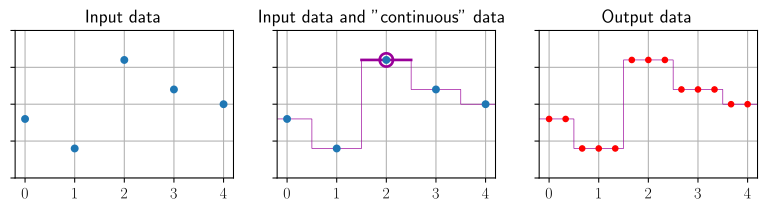
Figure 1:Illustration of the nearest neighbour interpolation on a 1D example. Blue and red dots represent the input and output image pixels, respectively. The purple line is the continuous data reconstructed from the input pixels.
In 2D, a first 1D interpolation is made on each row of the image, then a second 1D interpolation is made on the columns. Figure 2 shows and example of nearest neighbour interpolation.
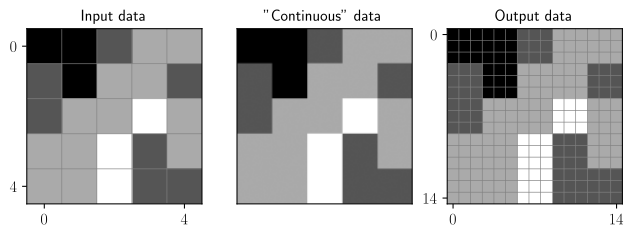
Figure 2:Example of nearest neighbour interpolation with a scaling of factor of 3. From left to right: original 5×5 image (input data), continuous data, interpolated 15×15 image (output data).