Image registration is the process of applying geometric transformations on images so that they lie in the same coordinate system. Registration has many applications, for instance in remote sensing (Figure 1), medical imaging (Figure 2), or photograph stitching (Figure 3).
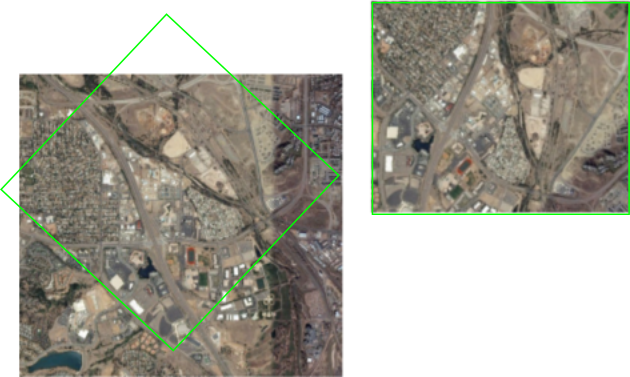
Figure 1:Registration of remote sensing images.
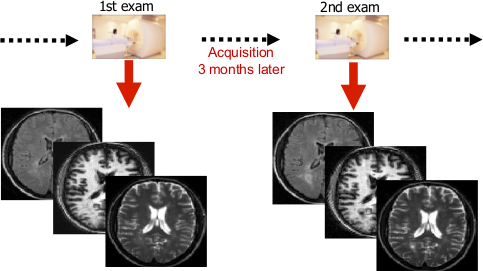
Figure 2:Change detection in medical imaging.
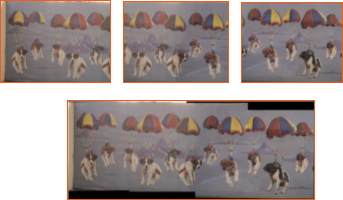
Figure 3:Photograph stitching.
The pipeline of image registration is illustrated Figure 4. In this example, the goal of registration is to find the transformation to apply on the source image so that the registered (transformed) image is similar to a reference .
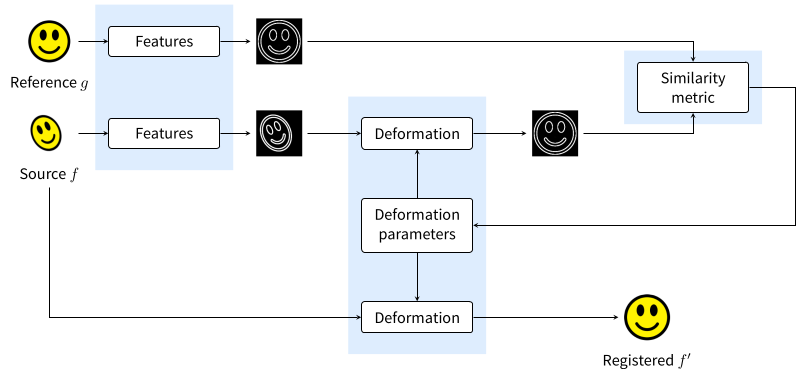
Figure 4:Image registration.
Most registration methods consist of the following three steps, which are highlighted by the blue regions in Figure 4 and detailed in the next sections.
Feature detection: distinctive objects (e.g. edges or corners) are identified in the reference and source images. For example, the chosen features in Figure 4 are the edges.
Deformation model: the transformation of the source image is defined by its type and parameters, with the optimal parameters determined by minimizing the similarity metric. An interpolation of the source image is then performed to generate the registered image.
Similarity metric: a correspondence between the features detected in the two images are established. The lower the similarity metric, the better the registration.