Here are two examples of lossless image compression.
Run-length encoding
RLE (run-length encoding) replaces a sequence of pixels of the same color with the number of pixels in that sequence. Therefore, the image Figure 1 needs 9 bytes to be stored without any compression. By reading the image column after column, the bytes are:
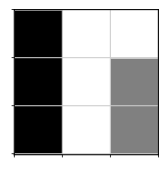
Figure 1:A 3 × 3 image.
We see 3 pixels with intensity 0, 4 pixels with intensity 255, and 2 pixels with intensity 128. Thus the image is encoded in RLE with only 6 bytes:
In this example, the compression rate is 6/9 = 2/3.
In computers, BMP format is based on RLE compression.
Lempel-Ziv-Welch Algorithm
The LZW algorithm (Lempel-Ziv-Welch, 1984) is an improvement of the LZ78 algorithm (1978). It is used in format such as GIF or TIFF. In short, the principle is to build a dictionary where the “words” are groups of pixels and to assign a code to each group. The dictionary is built during the compression stage and depends on the image.